
Twelve acres outside Bastrop sat on the market for well over a year. The owner had inherited it, never visited it, and signed a listing agreement without reading the commission line. When the sale closed, she called me to ask whether the brokers’ cut on her settlement statement was normal. It was, and that’s the hard part about what realtors charge on dirt in Texas.
Vacant land doesn’t sell like a three-bedroom ranch, with no kitchen to stage and no school district to brag about. The buyer pool shrinks to people who want acreage for one purpose, and agents set their fees with that in mind.
How Much Do Realtors Charge to Sell Land in Texas?
“So what’s this going to cost me?” That’s the first question I hear when somebody’s weighing a listing against a direct sale.
On houses, the numbers are well known. A February 2026 survey of agents pegged the total Texas commission on home sales at 5.88 percent, split roughly 2.93 percent to the listing side and 2.95 percent to the buyer’s side. Vacant land is another story, since what realtors charge on those Texas parcels usually runs higher. Agents won’t hide that if you ask.
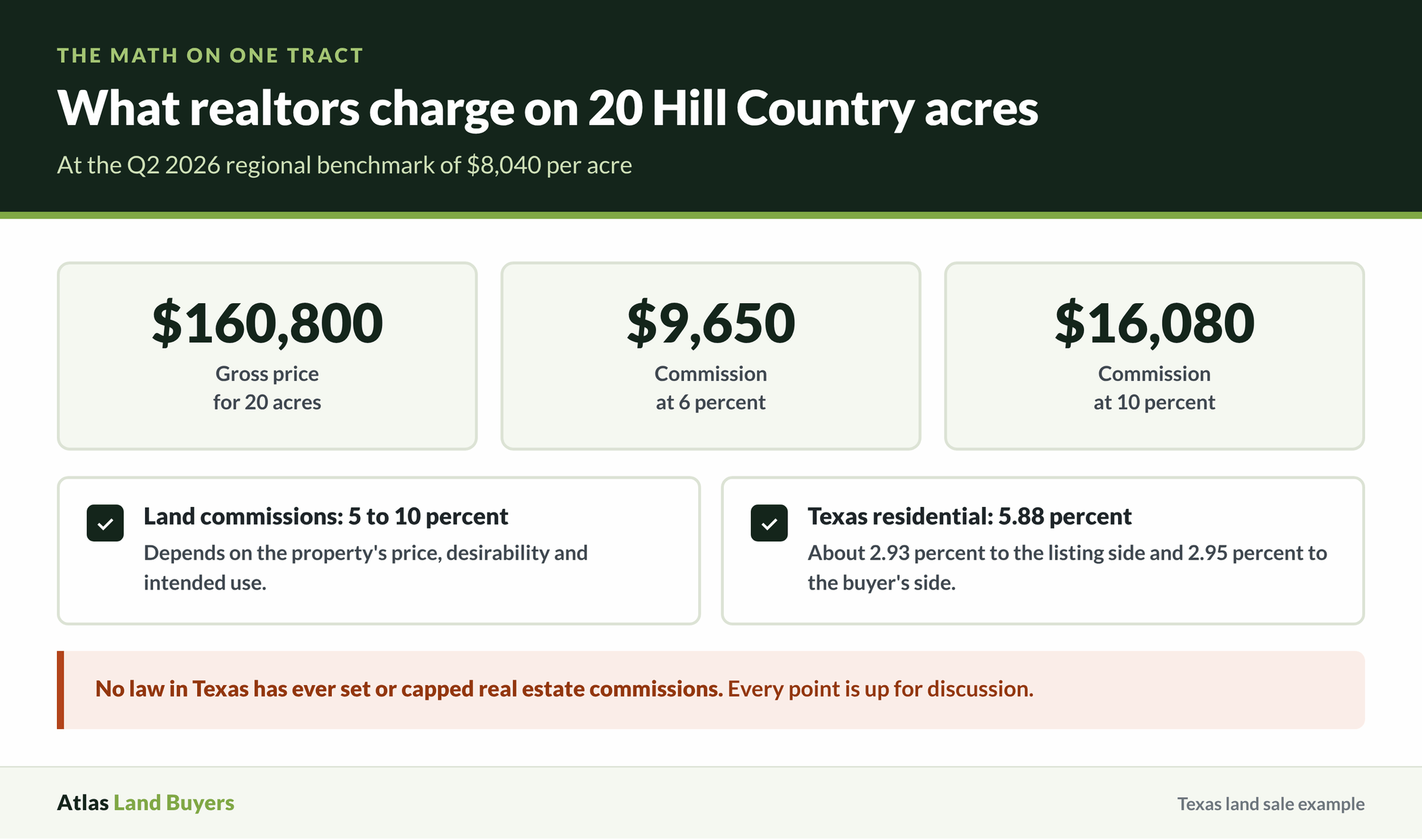
Sales data puts land commissions in a wider band than houses. Most land sales carry a commission somewhere from 5 to 10 percent. Where yours lands depends on the price, buyer demand and what the parcel is good for. Run the math on a real tract and the spread gets wide fast.
Take a 20-acre tract in the Hill Country as an example. The Texas Real Estate Research Center reported that the Austin-Waco-Hill Country region hit a record $8,040 per acre in the second quarter of 2026, up 8.63 percent year over year. Twenty acres at that benchmark is roughly $160,800. A six percent commission takes about $9,650 off the top. Push it to ten percent and you’re handing over more than sixteen thousand.
Nothing in state law sets that number, since Texas has never fixed or capped real estate commissions. Every point is up for discussion, though few sellers ever bring it up.
Tract size also shifts what realtors charge. Small lots carry higher rates because the dollar amount gets thin fast. A broker working a cheap half-acre lot outside Lubbock isn’t going to do it for three percent.
Why Do Realtors Charge Commission Fees to Sell Land?
Rural land across the state settled at $5,218 per acre in the second quarter of 2026. Prices were about flat against the first quarter and up 3.27 percent from a year earlier. Flat prices mean slower phones for listing agents, who still pay to market every slow month.
What realtors charge to market acreage pays for real work. An agent has to pull survey records and check whether the tract has legal access. Then there’s the mineral rights status, plus what the county says about septic rules. After that comes the marketing, with drone footage, boundary maps and plats. Raw land without a septic system carries more risk for the agent. A parcel meant for a mobile home can mean pulling drainage data, maps and well water test results.
Fewer buyers exist for a raw tract than for a house in Katy. That thin buyer pool is the core reason realtors charge more for land than for houses.
A couple of years ago I looked at eight acres near Seguin with an old farmhouse and a pole barn on it. The family’s agent had signed them at a land rate, a few points above what a house listing would carry. Nearly every showing went to people shopping for a house. By the end, the family was asking me what those extra points had paid for.
Volume tells part of the story too, since total dollar volume in the Texas rural land market fell 9.72 percent year over year in the second quarter of 2026. With less money changing hands, brokers work harder for each closing and price their time to match.
Does that justify double the house rate? For a small lot, maybe. On a 300-acre ranch where the commission runs into six figures, the work doesn’t scale with the fee. I think sellers should push back harder than they do.
What Percentage Do Realtors Charge for Land Sales in Texas?
Plenty of sellers tell me their agent said the rate is standard and non-negotiable. It’s not true, and it’s never been true in Texas.
Brokers who agreed among themselves on a standard commission would be breaking federal antitrust law. A listing agreement is a contract between two people. You can strike through a number and write a different one.
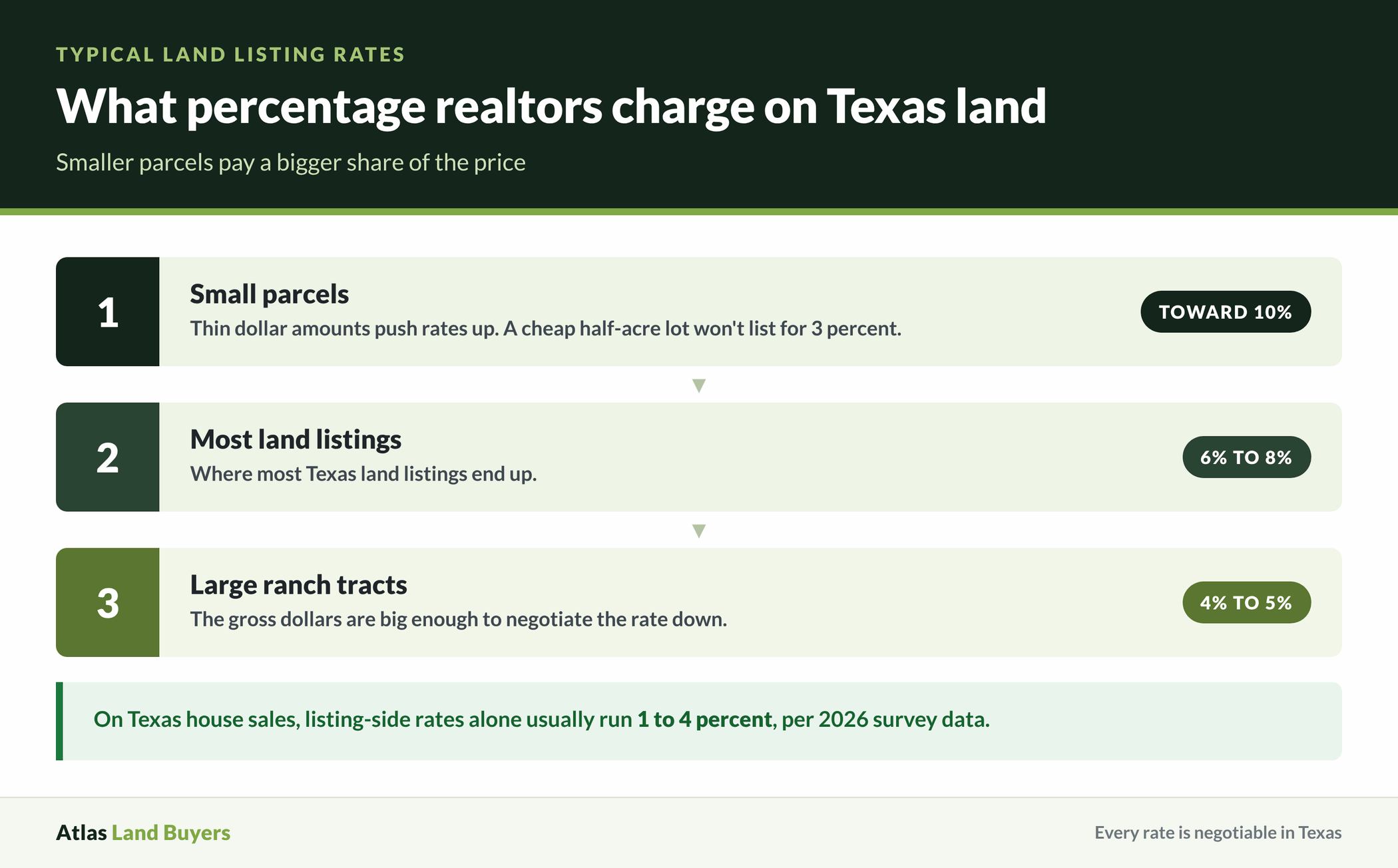
So what do realtors charge in practice across Texas? Most land listings I see fall between six and eight percent, with small parcels drifting toward ten. Large ranch tracts often get their commission negotiated down to four or five percent, because the gross dollars are big enough that the broker still eats well.
Region gets less attention from sellers than it deserves. In the second quarter of 2026, regional medians ran from about $1,139 per acre in Far West Texas and $1,719 in the Panhandle and South Plains to $3,008 in West Texas. The Gulf Coast-Brazos Bottom sat at roughly $11,369. One rate turns into very different money from one region to the next. A seven percent rate on Gulf Coast acreage near Brazoria writes a far bigger check than the same rate out past Van Horn.
Listing-side rates alone have room to move, with 2026 survey data on house sales showing Texas listing fees usually running from 1 to 4 percent. That’s a wide negotiating range on houses alone.
One pattern I keep seeing: sellers negotiate the sale price for weeks and sign the commission agreement in thirty seconds. Flip that habit. What realtors charge is the largest cost you control in a Texas land sale. It outweighs title insurance and the survey by a wide margin.
What Other Fees Do Realtors Charge Besides Commission?
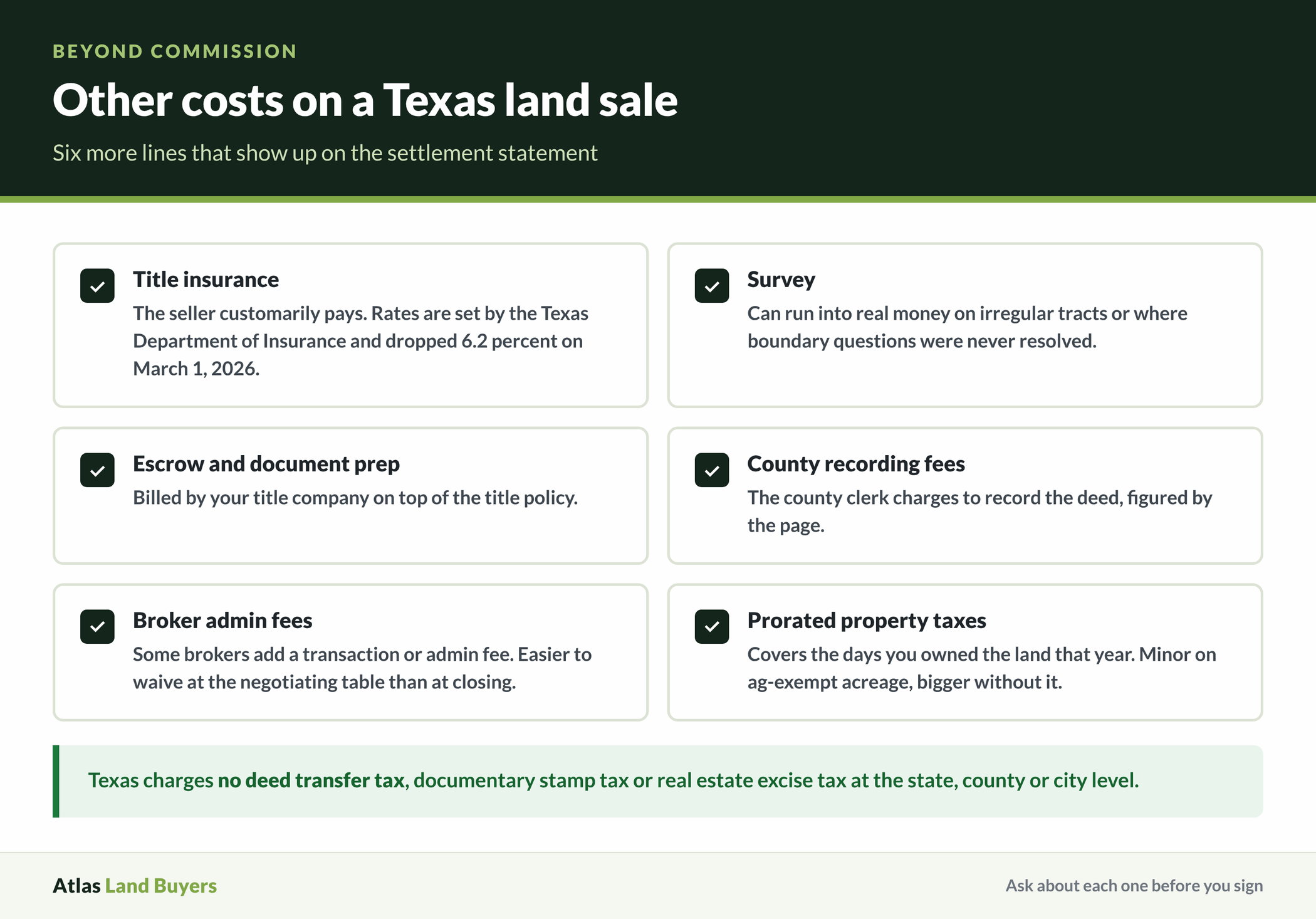
Many land sellers walk into closing thinking that one percentage is the whole bill. Then the settlement statement arrives with several more lines on it.
Title insurance is the big one, with the seller paying for the owner’s policy in most Texas sales. The Texas Department of Insurance sets title insurance premiums, so every title company charges the same premium for the same coverage. Shopping around on price won’t get you anywhere. The good news is that the Texas Department of Insurance cut basic premium rates 6.2 percent effective March 1, 2026, the first change to the rate schedule since 2019.
Surveys on raw land can cost real money, more so on odd-shaped tracts where boundary disputes with neighbors were never settled.
Beyond the title policy, your title company bills for escrow and document prep. The county clerk also charges a recording fee for the deed, figured by the page. Some brokers add a transaction or admin fee on top of what realtors charge in commission. It’s worth asking about those before you sign. They’re easier to waive at the negotiating table than at the closing table.
Texas spares you one cost that hammers sellers elsewhere. The state imposes no deed transfer tax, documentary stamp tax, or real estate excise tax at the state, county, or city level. You’ll never find that line on a Texas settlement statement.
Prorated property taxes come out of your proceeds too, covering the days you owned the land that year. Acreage taxed under an ag valuation barely feels it. On land that’s lost that valuation, it stings. Firms like Atlas Land Buyers handle those prorations directly. You get one net figure instead of a stack of deductions.
Can You Sell Land in Texas Without Paying Realtors?
For years I told sellers that for-sale-by-owner on acreage was a waste of time. I was wrong about that, at least partly.
Land buyers shop in their own way. They search by county, acreage and water access on land-specific platforms. Many of them find parcels without any agent involved. You can sell Texas land without paying what realtors charge in commission.
A flat-fee MLS route splits the difference. You pay a set fee up front to get listed, then owe commission only to an agent who brings a buyer. It drops the listing portion of what realtors charge, while the calls and showings land on you.
Direct sales to investors skip agents on both sides.
What you’re taking on is the work the broker would’ve done. It means pulling the deed and confirming the legal description matches the plat. You’ll also order the survey and run the earnest money through a title company in Tyler, Midland or wherever the land sits. Serious buyers will ask about utilities, easements and floodplain status. Vague answers send them elsewhere.
Have you ever tried explaining a metes-and-bounds description over the phone? It’s harder than it sounds.
My read is that for-sale-by-owner works well on clean tracts with road access and clear title, in a county where people are buying. It works poorly on landlocked parcels, heirship properties, or anything with a tangled chain of title. Avoiding what realtors charge only makes sense when the sale is simple enough to carry yourself.
Texas closings help here. You don’t need an attorney at the closing table, since a competent title company can carry most of the paperwork.
How Does What Realtors Charge Compare to a Direct Cash Offer?
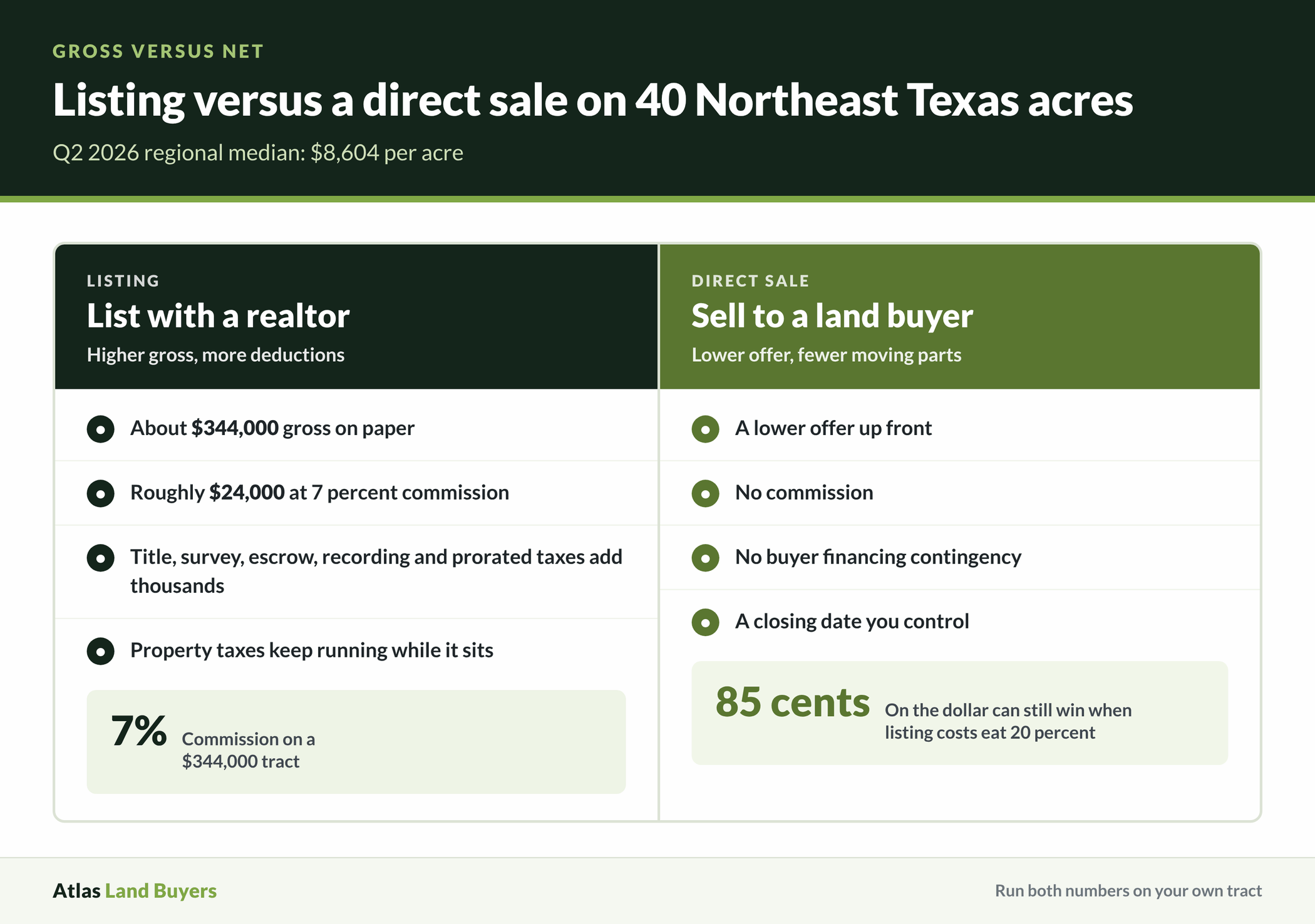
Sellers trip up here because they look at the headline price instead of the net.
List a 40-acre tract in Northeast Texas and your gross looks great. Land there ran $8,604 per acre in the second quarter of 2026, with a typical tract of 119 acres, though prices slipped 5.96 percent year over year. Forty acres at that median is about $344,000 on paper.
Now subtract what realtors charge. Seven percent in commission is roughly $24,000. The title policy, survey, escrow, recording and prorated taxes add thousands more on top of that. Then add a year or more of property taxes while the tract sits.
A cash offer arrives lower. That’s the trade, and anyone who tells you otherwise is selling something.
What a direct buyer removes is the risk. There’s no commission and no buyer financing contingency. Nobody springs a survey objection two weeks before closing either. Groups like Atlas Land Buyers close on their own funds. A lender can’t sink the sale by deciding the appraisal came in soft on raw dirt.
Run both numbers before you decide. When what realtors charge plus twelve months of holding costs eats twenty percent of your gross, a cash offer at eighty-five cents on the dollar comes out ahead. Prime Hill Country frontage with four interested neighbors is a different story, and I’d list it.
Nobody can tell you which applies without looking at your specific tract in Texas. The math isn’t universal, and I distrust anyone who claims it is.
Frequently Asked Questions About What Realtors Charge to Sell Land in Texas
Can You Negotiate What Realtors Charge on a Texas Land Listing?
Yes, and you should. Texas doesn’t set a standard commission rate, so the number on your listing agreement is just what you and the agent agreed to. Ask how much of it goes to the listing side and whether they add admin fees on top. You can also ask what happens if you find the buyer yourself.
Do Realtors Charge More for Vacant Land Than for Houses in Texas?
Most of the time, yes. Agents say land sits on the market longer and draws a smaller pool of buyers. They also have more legwork to do, like pulling plats, access records and utility details. Whether the higher rate is fair depends on your tract. If you’ve got a big, clean parcel in a good location, I think the usual house rate should cover it.
What Realtors Charge Versus Selling to a Land Buyer: Which Nets More?
That depends on your timeline and your land. A listing usually brings in a higher sale price on paper. Before any money reaches you, though, the commission, closing costs and months of property taxes come out of it. Selling direct to a land buyer gets you a lower number, but nobody takes a commission and you pick the closing date. Run the numbers both ways on your own tract before you decide.
Who Pays the Buyer’s Agent on a Texas Land Sale?
Since the 2024 rule changes, buyer compensation is negotiated separately rather than advertised through the MLS. Sellers in Texas often still contribute toward the buyer’s agent to keep the property competitive, but it’s a negotiated term, not an automatic one. Put whatever you agree to in writing before the property goes live.
Compare a Listing and a Direct Offer With Us
If you’re torn between listing your Texas land with an agent and selling it directly to us, we’re happy to run the numbers with you. Reach out to Atlas Land Buyers and you’ll get a straight answer about your tract. Sometimes that answer is that you’d net more by listing, and we’ll tell you so. There’s no obligation. Nobody’s going to chase you with a string of phone calls afterward, either.
If you want both numbers side by side for your tract, contact Atlas Land Buyers or use the form below. We’ll show you what a listing would likely net after commission next to a direct offer, and you can take it from there.