
A man called me about 22 wooded acres outside Lufkin that his uncle had left him, along with a 1988 survey and a stack of tax bills nobody had paid. He also had a lawsuit notice from the county’s collection firm. It had sat unopened on his kitchen counter for six weeks because he figured nobody would touch land with back taxes on it. He was wrong. Selling land with delinquent property taxes in Texas is legal, and it happens every week. What changes is how much you keep, and that comes down to how long you wait and who you sell to.
What Are Delinquent Property Taxes and Why Do They Matter When You Sell Texas Land?
A Texas property tax bill turns delinquent if it’s still unpaid on February 1, and from that day the county adds penalties and interest every month. Each year’s tax also creates a lien on the land itself. That lien stays with the dirt, not with you. It doesn’t go away when an owner dies, moves out of state or simply forgets the tract exists.
That’s why back taxes matter so much in a sale. A buyer can’t get clean title until every taxing unit is paid, and one rural tract can be billed by the county, a school district, a hospital district and sometimes an emergency services district. Each one holds its own claim.
Last year I sat with a retired couple from Waxahachie whose father had moved into assisted living. His 14 acres outside town had gone three years without a payment, and the deed was in a shoebox in the garage. They didn’t know who they owed. One afternoon at the Ellis County appraisal district cleared that up. Once they had the taxing units and account numbers written down, the rest of the sale finally had a map.
The lien is the problem a buyer has to solve. The taxes themselves are just a number.
Why Can You Still Sell Land with Delinquent Property Taxes in Texas?
You can sell because the tax balance gets paid out of the sale itself. The title company orders a tax certificate for the parcel, which shows every dollar owed to every taxing unit. At closing, the title company pays those amounts straight to the tax office, and you get what’s left.
Nobody needs you to pay the taxes first, and that surprises a lot of owners. They assume they have to scrape together thousands of dollars before they can even list the land. They don’t.
Plenty of situations land people here. Heirs inherit acreage that a parent stopped paying on years earlier, and out-of-state owners forget about a lot they bought decades ago. Sometimes a divorce or a job loss pushes one bill past due, and then the next year’s bill stacks on top. If heirs need to convey land through probate, that step has to happen before closing too.
There’s one real limit. The land has to be worth more than what’s owed, or nobody will buy it. On most Texas acreage that isn’t close, since the Texas Real Estate Research Center put statewide rural land prices at $5,218 per acre in the second quarter of 2026. A few years of back taxes rarely eats through that.
How Does Selling Tax Delinquent Land Work in Texas?
Start with the appraisal district record and write down the property ID and legal description. You don’t need a tidy street address to sell rural land, because the parcel ID does the job.
Next, ask the county tax assessor-collector for a written payoff. Don’t use the appraisal district for this. It sets value but doesn’t collect a dime, while the tax office knows the real balance with penalties and attorney fees included.
Then order a title search early. Back taxes are often only one of the problems on a rural tract, and old mortgages, missing heirs and judgment liens tend to show up in the same search.
Once you accept an offer, the title company handles the payoff, and delinquent taxes come out at closing along with everything else. A cash closing on Texas land usually takes two to four weeks. The biggest wait is often the tax certificate coming back from the county.
Get the net figure in writing before you sign anything. You should know exactly what lands in your account after the county is paid.
How Much Do Delinquent Property Taxes Cost You in Texas?
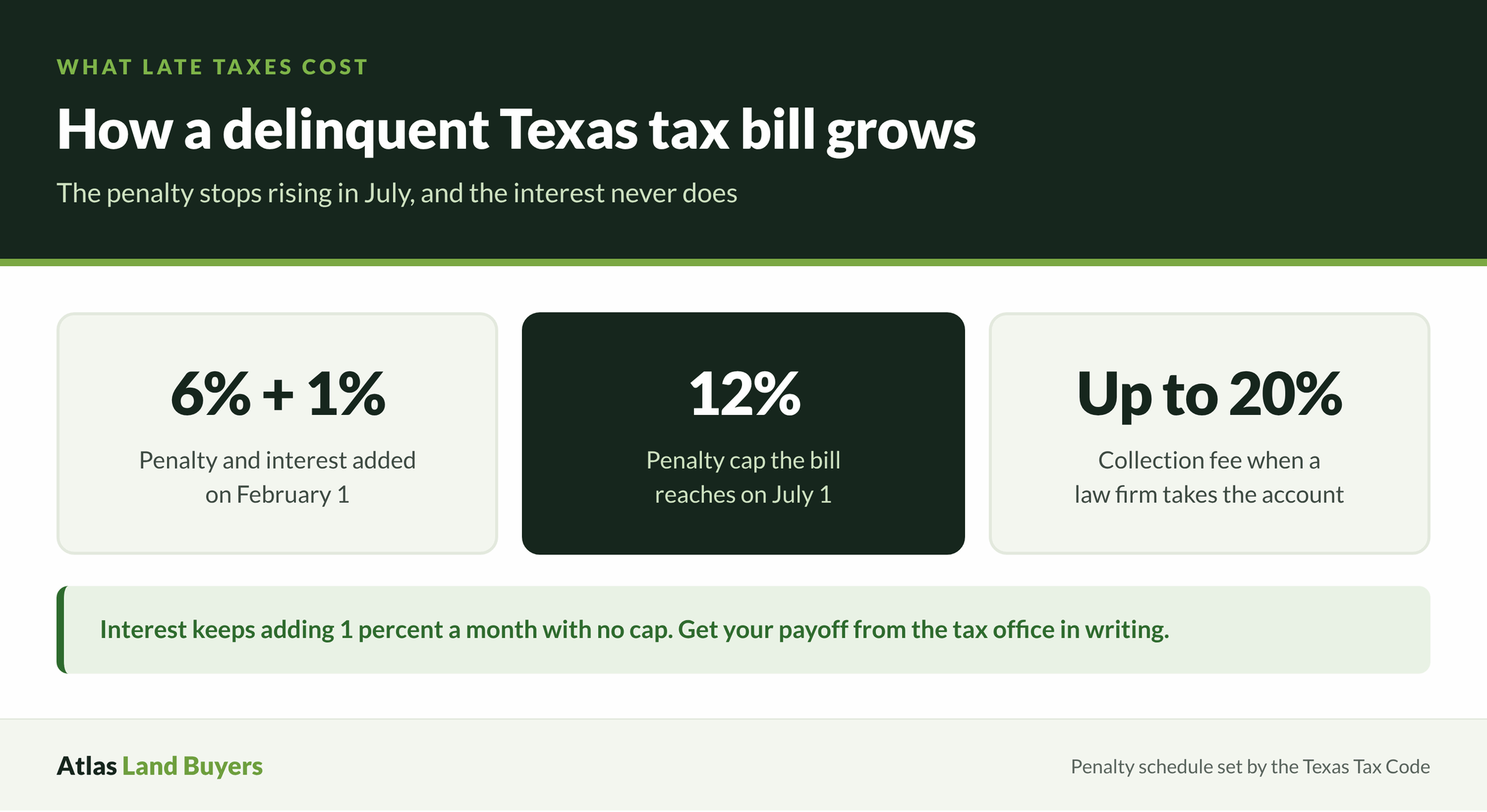
State law sets the penalty schedule, and it climbs fast. As the Texas Comptroller explains, an unpaid bill picks up a 6 percent penalty and 1 percent interest on February 1. The penalty grows by another point each month until July 1, when it reaches 12 percent and stops rising.
Interest doesn’t stop. It keeps adding 1 percent a month for as long as the bill sits there, with no cap.
Then there’s the collection fee. Many taxing units hire private law firms to chase unpaid bills, and those firms can add up to 20 percent on top of the tax, penalty and interest combined.
Here’s a simple example. Say a Van Zandt County tract carries four unpaid yearly bills of $4,000 each, which adds up to $16,000 in base tax before anything else. Put a 12 percent penalty on each year, add several years of monthly interest and then stack a 20 percent collection fee on the whole thing. The payoff can land well past $20,000. Your exact figure depends on dates, so get it from the tax office in writing.
What Factors Affect How Much You Walk Away With?
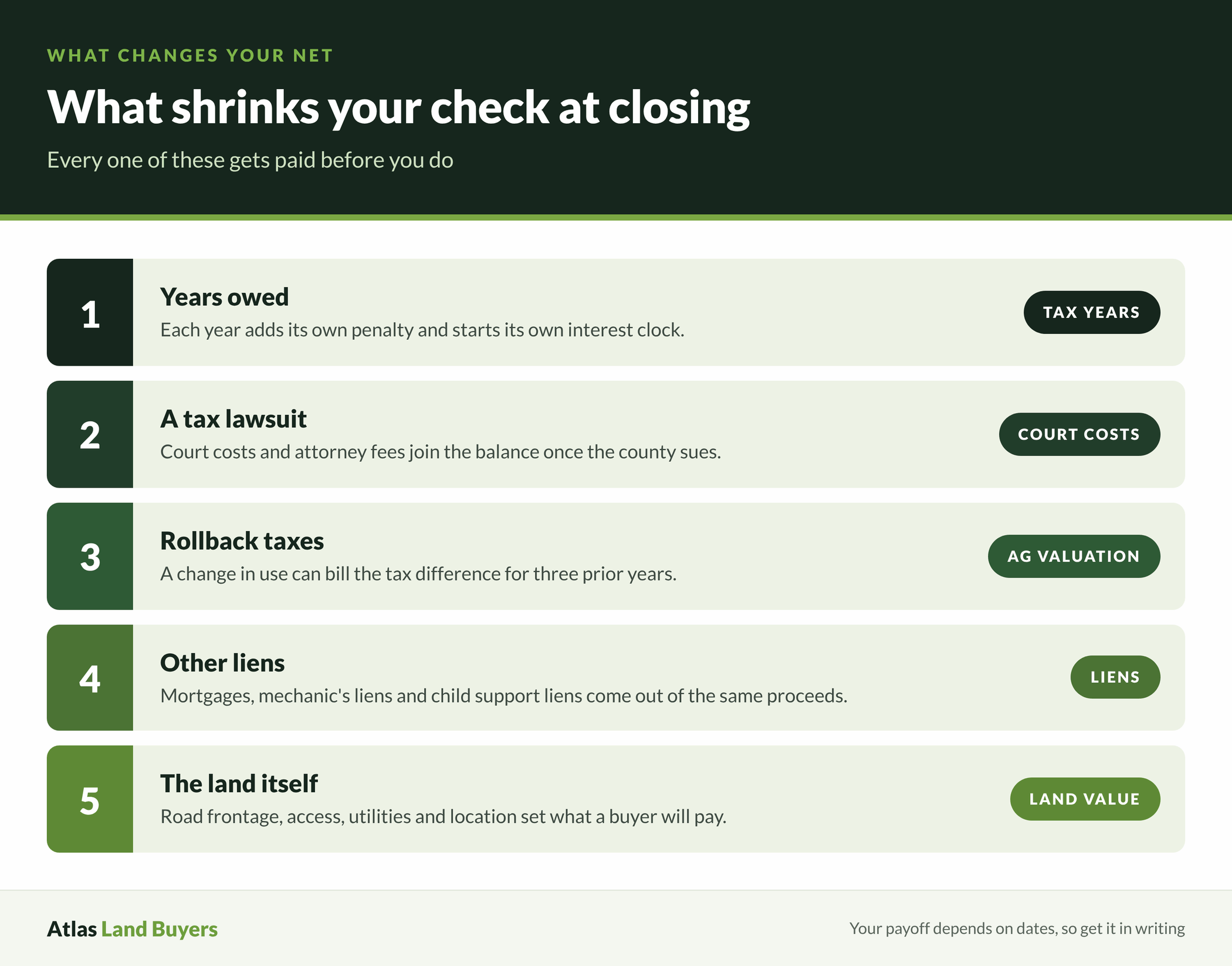
The number of years owed is the big one, since each year adds its own penalty and starts its own interest clock.
Whether a lawsuit has been filed matters next. Once the county sues, court costs and attorney fees join the balance, and the sale has a deadline it didn’t have before.
Rollback taxes catch a lot of rural owners off guard. If your land had an agricultural or open-space valuation and the use changes, the county can bill the tax difference for the three prior years. A 2021 law dropped the interest on most of those bills, which helped. Still, any buyer who plans to build or subdivide will ask about it.
Other liens count too. A mortgage, a mechanic’s lien or a child support lien all get paid from the same proceeds as the taxes.
Finally, the land itself sets the ceiling. Road frontage, legal access, utilities and location drive what a buyer will pay, so two tracts with the same tax balance can leave their owners with very different checks.
How Does Selling Delinquent Land Compare to Selling Land with Taxes Paid?
The paperwork is mostly the same. The buyer pool is not.
Land with current taxes can go on the MLS and wait for a retail buyer. Many of those buyers need a loan, and lenders won’t fund until title is clean. Some walk away the moment they spot a tax suit in the county records. Even without tax trouble, a traditional MLS listing on rural land can sit for months.
Delinquent land draws a smaller group of cash buyers, investors and neighbors who already know the tract. They’re used to handling a payoff at closing and don’t flinch at a tax certificate with a big number on it.
I worked with an heir in Beaumont who was handling her mother’s half-acre. She tried two agent listings back to back, and both expired over nine months with zero offers while a rusted horse trailer sat on the lot the whole time. By the time she called a direct buyer, the delinquent balance had about doubled.
Time costs more on delinquent land than on any other kind. Every month you wait shows up in the payoff.
How Can You Lower What You Owe Before You Sell?
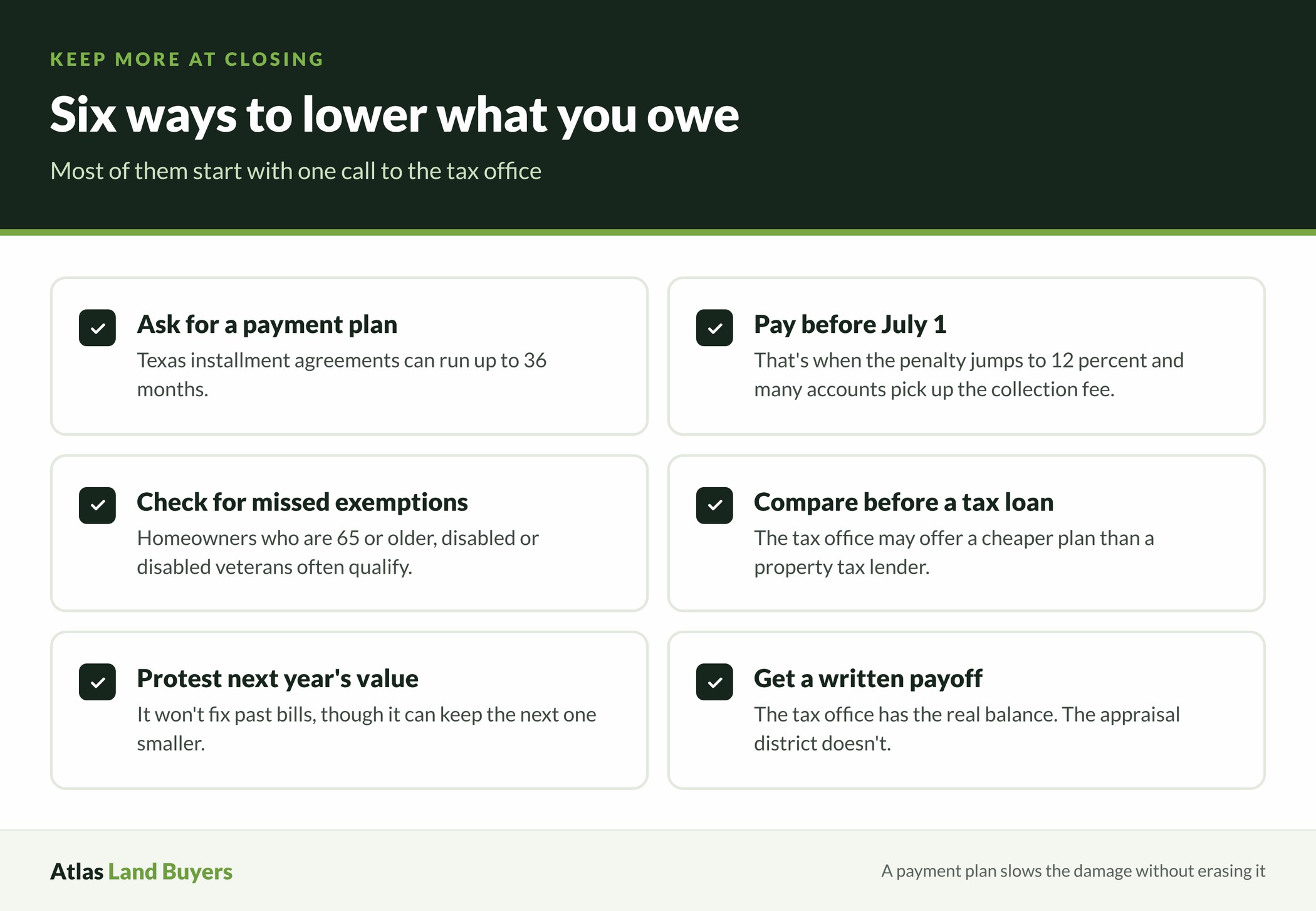
Ask the tax office about a payment plan first. Texas lets collectors set up installment agreements that run up to 36 months. While you stay current, the county can’t sue you or sell the land for those taxes. Interest and penalties still build on the unpaid part, so a plan slows the damage without erasing it.
Pay before July 1 if you can. That’s the day the penalty jumps to 12 percent and many accounts pick up the collection fee.
Check for missed exemptions as well. If your home sits on the land, you may qualify for breaks you never filed for, especially if you’re 65 or older, disabled or a disabled veteran. The appraisal district can tell you what applies.
Be careful with property tax loans. A lender pays the county and takes over the tax lien, and some of them charge high rates and fees. Texas even makes these lenders tell borrowers that the tax office may offer cheaper plans. Compare both before you sign.
Look at next year’s value too. If the appraisal district has your land valued too high, you can protest it. That won’t fix past bills, though it can keep the next one smaller.
How Do You Prepare Your Land for a Sale with Back Taxes?
Pull together one folder before you call anyone. Put the deed in it along with any survey you have, the written payoff from the tax office and the appraisal district printout. If there’s a lawsuit, include the petition and any court dates. Heirs should add the death certificate and the will or probate papers.
Don’t hide the balance. Tell any buyer what’s owed on the first call, because it’ll show up on the tax certificate anyway and a surprise late in the process can sink a sale.
Make sure a buyer can reach the land. Write down the gate code, the road it’s off and which neighbor has a key. Rural tracts without clear access almost always take longer to sell.
Walk the boundary if you can, and look for the corner pins or at least the fence lines. Clear a path to them if the brush is thick.
Note anything that adds value. Road frontage, a water well, power at the line or a stock pond can all matter to a buyer, and so can timber or a pipeline easement that pays.
The Waxahachie couple had nearly all of this in that shoebox. Once it was sorted into one folder, the hardest part of their sale was done.
Frequently Asked Questions About Selling Land with Delinquent Property Taxes in Texas
Will a Title Company Close on Texas Land with Unpaid Taxes?
Yes. Title companies close on delinquent land all the time. They order a tax certificate, take the payoff from the sale proceeds and send it to the tax office at closing, so the seller doesn’t need to pay first. What a title company won’t do is close if the price can’t cover the taxes and other liens. In that case, someone has to bring money to the table.
Can You Sell Land While the County Is Suing for Back Taxes?
Usually, yes. A tax suit doesn’t block a sale by itself. The title company gets the full payoff, including attorney fees and court costs, and pays it at closing. Once the taxing units are paid, they can drop the suit. Timing is the catch here, because if a judgment has been entered and a sale date set, you’ll need to close before that date. Read more about selling land in foreclosure.
Can a Payment Plan Stop a Tax Sale?
It can, as long as you keep up with it. Under a Texas installment agreement, the county can’t file suit or sell the land for the taxes in the plan. Miss a payment or let a new year’s bill go unpaid, and that protection ends. Penalties and interest keep building during the plan, so it buys you time more than it saves you money.
Can You Get Your Land Back After a Texas Tax Sale?
Sometimes. Texas gives owners a right of redemption under Tax Code Section 34.21. Homestead and agricultural land gets two years from the date the buyer’s deed is recorded, while most other land gets 180 days. You’d repay what the buyer paid plus certain costs, and then add a premium of 25 percent in the first year or 50 percent in the second.
What Happens to Extra Money If Your Land Sells at a Tax Sale?
If the tax sale brings in more than the judgment and costs, the court clerk holds the extra and you can file a claim for it. You have two years from the sale date, and that clock starts at the sale, not when a notice reaches you. After that, the money goes to the taxing units. Tax sales also tend to bring low prices, so selling before one usually leaves you with more.
Selling Tax Delinquent Land Near Dallas
Owners with acreage in Ellis, Kaufman, Van Zandt and other counties around the Metroplex face the same state penalty schedule as everyone else. If a law firm’s letter shows up, call the county tax office for a payoff anyway, since the firm collects for the county and the tax office can confirm the real number. We buy land statewide, including from landowners around Dallas and across our Houston markets.
Get a Straight Answer Before the Next Tax Sale
If you own Texas land with back taxes, we’re glad to talk through your options with you. A payment plan might fit you better than a sale, and we’ll tell you if it looks that way. If selling makes sense, Atlas Land Buyers can make a cash offer and handle the payoff with the county at closing. There’s no fee and no obligation. Reach out here or share a few details about your land in the form below.